Just Do It

I’m sorry to steal your tag line, Nike, but it’s a good one.

I’ve struggled quite mightily with blogging about my travel experiences. I struggle with blogging in general. It’s all so much navel-gazing and seems too self important. I don’t have any delusions that what I have to say is that important – it. is. not. I’m probably not even terribly original. People travel. They have incredible experiences. They write, far better than I do. So what if I blog? Who cares? The Internet is choked with ego, blowhards, miscreants, as well as well-meaning people who like to share what they do or who like to participate in conversation, even if it’s from their mom’s basement. Everyone, anyone can do it, no talent necessary. Continue reading

Posted in Uncategorized | Tagged , , , , | 2 Comments

Echoes

I hesitate to tell this story. One, because it’s deeply personal and two, because it might appear that I lost a marble or two in Peru. But I will tell it anyway because it made an impact on me, and because perhaps you have  had an experience like it yourself.

On the morning we awakened on the altiplano (high plain), our overnight home at 12,000 feet in the Andes, about half the group hiked up to the Inti Punku, the Door of the Sun, at the summit. I elected to stay back with the other students and use the time to meditate. After a little more than an hour of meditation I decided to explore the canteras, the quarries. From the moment we arrived the day before I was incredibly drawn to the stone pathways laid by the Inca. I wanted to walk along them, see where they went. I wanted to touch and explore the stones left where they fell centuries ago.

I descended the campsite to the quarry area. Smooth, accurately-cut huge stones litter the site. You can tell  that the stones were cut by humans, although it’s difficult to fathom how they achieved the feat without modern machinery. It is said that some stones from this mountain quarry were hauled off and used to build Machu Picchu. How I’ll never know, since Machu Picchu is about two hours away by train. But miracles inhabit Peru. Continue reading

Posted in Uncategorized | Tagged , , , , , , | Leave a comment

Into Thin Air

My post on the Westtown School Senior Projects’ Blog

When the students saw on our itinerary that there would be an “overnight trek high into the Andes,” they asked for more. “Can’t we do another one?” So before we departed, Maria and I asked World Leadership School to add a day of hiking to our plans. The representative knowingly chuckled, “Let’s just see how this one goes first. It’s hard, you know, climbing at those altitudes.”

She was right. Climbing a mountain is one thing. Climbing one in the Andes when you begin at 10,000 feet is quite another. I am not a mountaineer, nor even a regular climber, but I had been “training” for several weeks for this trek. By training I mean walking on the treadmill at a #5 incline.

When we arrived to Ollantaytambo and one of our guides pointed high in the sky and said, “that’s where we’ll camp in a few days,” I had to laugh.  Out of fear, I mean. The treadmill training suddenly seemed so insignificant, and all those steps in preparation so lame in comparison to the imposing monstrous peak before us.

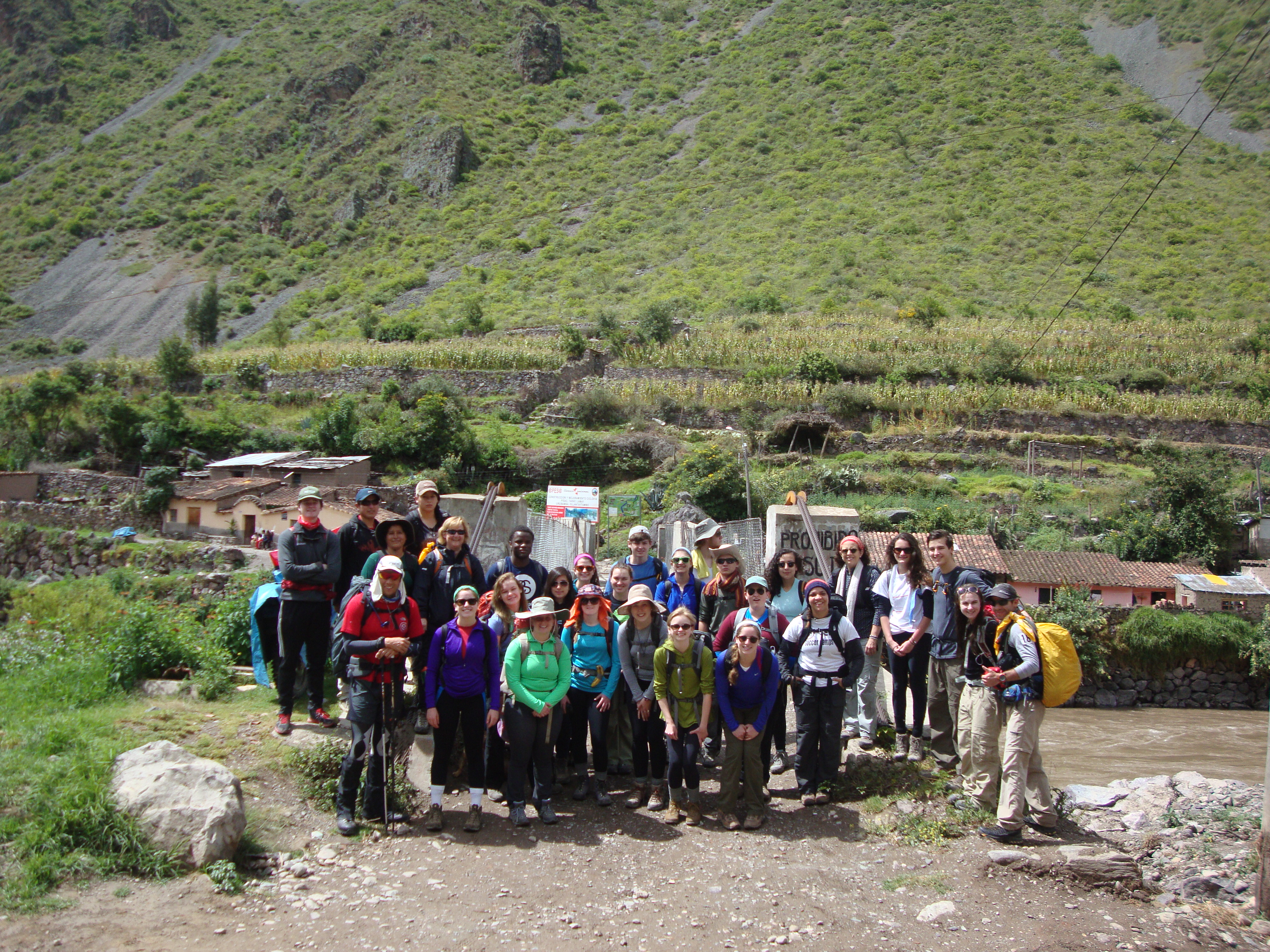
We set off on a sunny Saturday morning. We walked out of the village,  packs on our backs, faces smeared with sunscreen (which is, unfortunately, nearly ineffective so close to the blazing sun) and waters bottles full. The porters and the 14 beasts of burden carrying sleeping bags, tents, food, water, fixings for snacks and meals and sundry items had left before us so they could ready the campsite. Spirits were high and the students seemed undaunted by trail before us.

Leaving Ollantaytambo

Leaving Ollantaytambo


The trail rose slowly at first and the hills filled with the sounds of laughter and chatter. Then the trail steepened sharply. The group began to spread out; eager hikers in the front, the lung- and leg-challenged in the back. Perhaps you can guess where Maria and I found ourselves – but I will say that it wasn’t really the strain on our limbs that slowed us, it was the altitude. As the air thinned, the sounds of panting replaced the chatter. And rightly so.

Still, the mood never dipped. We all felt grateful to be surrounded by such beauty, such history. The mountains, though terrifying in some ways, also impart a feeling of joy. They are home to the Andean people and this feeling of ‘home’ is somehow inexplicably palpable. We all stopped several times along the trail to survey the amazing mountain scape, to see how tiny the rooftops of the village had become. Well, we stopped to catch our breath and then appreciate the beauty around us.


Continue reading

Posted in Uncategorized | 2 Comments

Andes Mountain High

I wrote this post several days ago for Westtown’s Senior Projects Blog

The two-hour bus ride from Cusco to Ollantaytambo allowed us to behold the Andes for the first time. Gasps were audible as the kids scrambled for their cameras, elbowed their neighbors, exclaiming, “Look at that!” I felt as if I’d never seen a mountain before these; hills and bumps, maybe, but not a real mountain. The imposing rocks jut sharply toward heaven and are something to be with reckoned with, for sure. Be careful here. But they are also majestic and breathtakingly beautiful. Oddly, they also seem welcoming. Perhaps it’s because they inspire such awe that we feel beckoned unto them.

We stopped along the road to take in the vistas and, I’ll just be honest, to use the bathroom. (Will I never again take a trip without a kid asking to stop to use the potty?) We tumbled off the bus and our relationship with the Andes began. Students sat down to stare at them. A few began to meditate. We hadn’t reached our destination yet and already we felt moved by this extraordinary space on the planet. It made me hunger for knowledge about the people who chose to carve (very literally) a civilization into these monstrous, unforgiving mountains.

Our home for two weeks is the village of Ollantaytambo, perched  in small valley where about six craggy peaks meet.  This was an Inca stronghold in the Cusco province and the estate of Emperor Pachacuti. It’s an amazing archaeological site and the footprints of the Inca have not been washed away by time. You can see the Inca everywhere, not just in the ruins that surround us, but in the faces of the inhabitants. You can hear the echo of their voices in the local tongue.

We met our representatives from World Leadership School who, on the first day, sent the students on a Global Issues Scavenger Hunt. The kids divided into teams and, without maps, had to find local products, sites or items. How do you do that without a map? How do you find items that you’ve never heard of before, such as a chakana? You ask the locals. It was a clever way to quickly break down barriers to interacting with villagers, to learn the layout of the town together, and to simply learn what things are called. The students relished this competition won not by speed, but by quality of their answers.

Yesterday we hiked the massive ruins built on the side of a mountain, arriving at the Sun Temple. To stand in the Temple and survey the expanse around us left us as breathless as the altitude.  We saw specks of orange rooftops of our little village below. We saw the mountain we will climb for our trek and overnight camping. We saw the granaries of the Inca built impossibly high, magically high, otherworldly high on an adjacent peak. It’s difficult to comprehend the lives once lived nearly dangling from a precipice.

After our descent from the Sun Temple, we were guided to another sacred space in the ruins. There, we sat in silence to meditate and to journal. It was a profound silence broken only by the sounds of birds and the winds of the past and future.

What treasures will the Andes share with us next?
 

Posted in Uncategorized | Tagged , , | 2 Comments

Past Is Present

As I ready myself for the sojourn to Peru, I’ve been thinking a lot about the past. There is history in every location and it’s often historical sites that lure tourists: buildings and monuments of  a time long ago, museums packed with art and artifacts of previous lives.  Of course every city, every society, every family and every person  is imprinted with the past. As individuals  we will be bringing our luggage and our baggage, full of preconceived notions, memories and patterns of behavior.

Yet most of the places my travels have taken me to are also modern. The passage of time shows in their ever-evolving languages, their new constructions, their attitudes. The Internet, TV and movies, the ease of modern travel and the popularity of foreign cuisine have made us more connected to and aware of other cultures. Major world cities, while each retaining their own personalities, have even begun to look more alike. It’s as easy to find a McDonald’s in New York as it is in London or Paris. And globalization is evident nearly everywhere.

But we are traveling to a place where the past is still very much present – or more present than in any location I’ve been to. The villagers still speak Quechua, derived from the ancestral language of the Inca. The Andeans still live much as they did centuries ago, farming potatoes and quinoa, observing religious rites that have been passed down through the years and raising families without Facebook.  The inhabitants of the Sacred Valley live a simple, agrarian life nearly untouched by the rest of the world.  Many still wear traditional garb, uninfluenced by world fashion trends, although I hear that baseball caps are popular among men and jeans have made their way to closets.

All of this stands to reason in a place that is remote. The Sacred Valley is tucked away in the formidable Andes mountain range. It is isolated by geography. Ollantaytambo (the village where we will spend most of our trip) apparently has an internet cafe and many of the homes now have plumbing and electricity, but otherwise remains primitive, for lack of a better word. While this might make some nervous, it’s this aspect of the trip that I find one of the most exciting – as well as somewhat terrifying. Living a simpler life – a past life – and going off the grid may present a great challenge to me and the students (what on earth will we do without our electronic limbs- our cell phones?!), it also stands to be our greatest reward.

The past will be a present.

Posted in Uncategorized | Tagged , , , | Leave a comment

Letting Go

I’m a travel geek of the highest order. When I decide I’m going on a trip I collect and read guide books, memorize phrases in the native language and study maps. I learn about the history and culture of the country and cities I will visit. I stuff my head with trivia about the locale. I study up on etiquette, lest I unknowingly make an obscene gesture. (In some countries our ‘OK’ sign, which is the forefinger and thumb making a circle, is a gesture equivalent to calling someone an  a-hole, just so you know.)  I learn as much as I can, desperately wanting to be polite, respectful and to fit in.   I make sure that I don’t wear a fanny pack and white sneakers which are neons signs that blink “American Idiot. American Idiot.” Yes, I’m terrified of making a faux pas, which I count both as an asset and a liability.

My upcoming  trip to Peru is no different from my other travels in some ways. I’ve mapped, I’ve studied, I’m learning some Quechua (oh so poorly) and I’m brushing up on my Spanish. I’ve studied the weather patterns and the terrain, so I’m ready for the cold and rain and steep hikes.  My duffel bag is packed with appropriate clothing. (But no fanny packs  – they are still and always will be a no-no. Seriously, people, it’s not the 80s.) In other ways it’s completely different. I am co-chaperone to 21 students, about the furthest you can get from solo travel. Being responsible for all those kids ups the ante, for sure, and has put my geekdom on high alert – preparedness is key. BUT, I’ve decided to practice the art of letting go because here’s the truth: the beautiful thing about travel is the unknown and the unexpected. Any frequent traveler will tell you that the best experiences are those for which you are unprepared.  It’s useful to be oriented to place and time, but it’s also useful to be lost, to encounter a place or a person that wasn’t on your itinerary. Letting go also means embracing the ability to say yes to something you might not otherwise do, ceding control, and getting out of your comfort zone. Continue reading

Posted in Uncategorized | Tagged , , , | 2 Comments